From Rough to Polished: The Ultimate Gemstone Guide
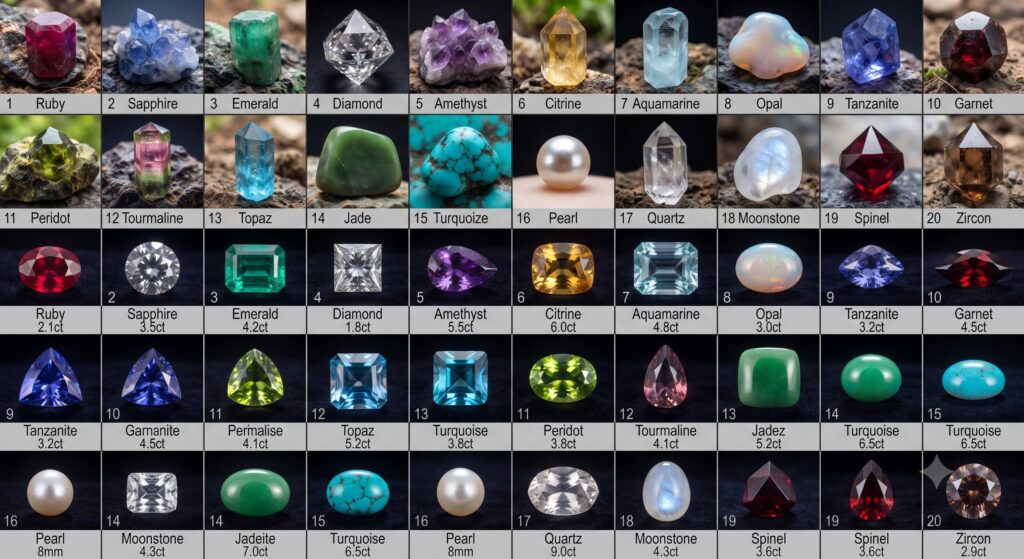
Welcome to our comprehensive visual and market guide for 20 of the world’s most sought-after precious materials. Below, you can see the incredible transformation these stones undergo from their raw, natural state to a precisely faceted final cut.

Understanding Carat Weight & Pricing: In the gemstone market, there is no strict “minimum” or “maximum” carat weight. Stones can be cut into tiny fractions of a carat (melee) or left as massive museum specimens. One carat is exactly 200 milligrams. For rare gems, the price per carat increases exponentially with size—meaning a 2-carat stone often costs much more than double the price of a 1-carat stone.
Market Value Breakdown
| # | Material | Approximate Value (USD) | Sizing & Pricing Notes |
|---|---|---|---|
| 1 | Ruby | $4,625 per carat | Price increases exponentially with size; color (e.g., “pigeon’s blood”) is the dominant value driver. |
| 2 | Gold (Nugget) | Priced by purity/weight | Gold is measured in karats (purity) and grams/ounces, rather than gem carats. |
| 3 | Diamond | $4,500 – $6,000 per carat | Highly dependent on the 4Cs; per-carat price increases exponentially as the gem size increases. |
| 4 | Emerald | $500 – $1,100 per carat | Emeralds are less dense than rubies, so a 1-carat emerald will appear physically larger than a 1-carat ruby. |
| 5 | Sapphire | $450 – $1,600 per carat | Clean, large stones in rich cornflower blue command premium per-carat prices. |
| 6 | Amethyst | $15 – $100 per carat | A more affordable gemstone; value is driven by depth of color. |
| 7 | Topaz | Varies widely by type | Imperial Topaz is rare and highly valued, while standard blue topaz is much more abundant. |
| 8 | Aquamarine | $100 – $200 per carat | Generally more affordable than precious gemstones, varying by color saturation. |
| 9 | Opal | $60 – $100 per carat | Classified as an affordable gemstone; price depends heavily on the play-of-color. |
| 10 | Garnet | Varies by variety | Varieties like Tsavorite command extremely high prices due to their superior characteristics and rarity. |
| 11 | Peridot | $50 – $80 per carat | Known for its olive-green color; priced as an affordable gemstone. |
| 12 | Tourmaline | Varies by variety | Rubellite and watermelon tourmaline often exhibit visible inclusions but are still highly valued. |
| 13 | Tanzanite | Highly variable premium | Commands high prices due to single-source origin (Tanzania), despite a lower Mohs hardness of 6.5. |
| 14 | Spinel | $200 – $500 per carat | Commands high prices for superior characteristics; a highly valuable alternative to ruby or sapphire. |
| 15 | Morganite | Varies by cut/clarity | Price relies on clarity and carat weight; larger stones allow for better pastel color saturation. |
| 16 | Zircon | Varies widely | High-end retail pieces featuring Zircon can range from $4,238 to $6,359 depending on setting/size. |
| 17 | Jade | $10 – $100,000+ per ct | Extremely massive variance; “Imperial Jade” commands the absolute top of the market. |
| 18 | Turquoise | $10 – $100 per carat | Affordable, opaque stone; typically cut into cabochons rather than faceted. |
| 19 | Moonstone | Varies by cut/clarity | Price is driven by the visual effect (adularescence) and quality of the cabochon cut. |
| 20 | Quartz | $8 – $65 per carat | Abundant globally. The price per carat remains fairly constant even as the weight of the stone increases. |
Key Value Factors to Remember
- Color vs. Clarity: For colored gemstones (like Rubies, Emeralds, and Sapphires), color is the single most important determinant of value. Stones that are too light or too dark are less desirable than vivid, medium tones.
- Carat Scaling: With common stones like quartz, heavy carat weights are easily affordable. With rare stones like diamonds, the jump in price from 1 carat to 2 carats is not linear, but exponential based on rarity.